


07 Jan What Temperature is Needed for Mudjacking?
Mudjacking is a reliable and budget-friendly way to repair heavy concrete slabs without ripping them out and pouring new ones. By pumping a slurry underneath the concrete slab, it is lifted up back into its original position.
But, it takes more than just pumping “mud” under the ground to make mudjacking a success. It is a chemical and physical process that’s highly sensitive to the weather.
Contractors pay close attention to the thermostat as a big factor to a repair that lasts for years is temperature. If it’s too cold, the mixture won’t set, and if it’s too hot, it might dry out and shrink.
Let’s break down what temperature is needed for mudjacking and how the environment affects your concrete.
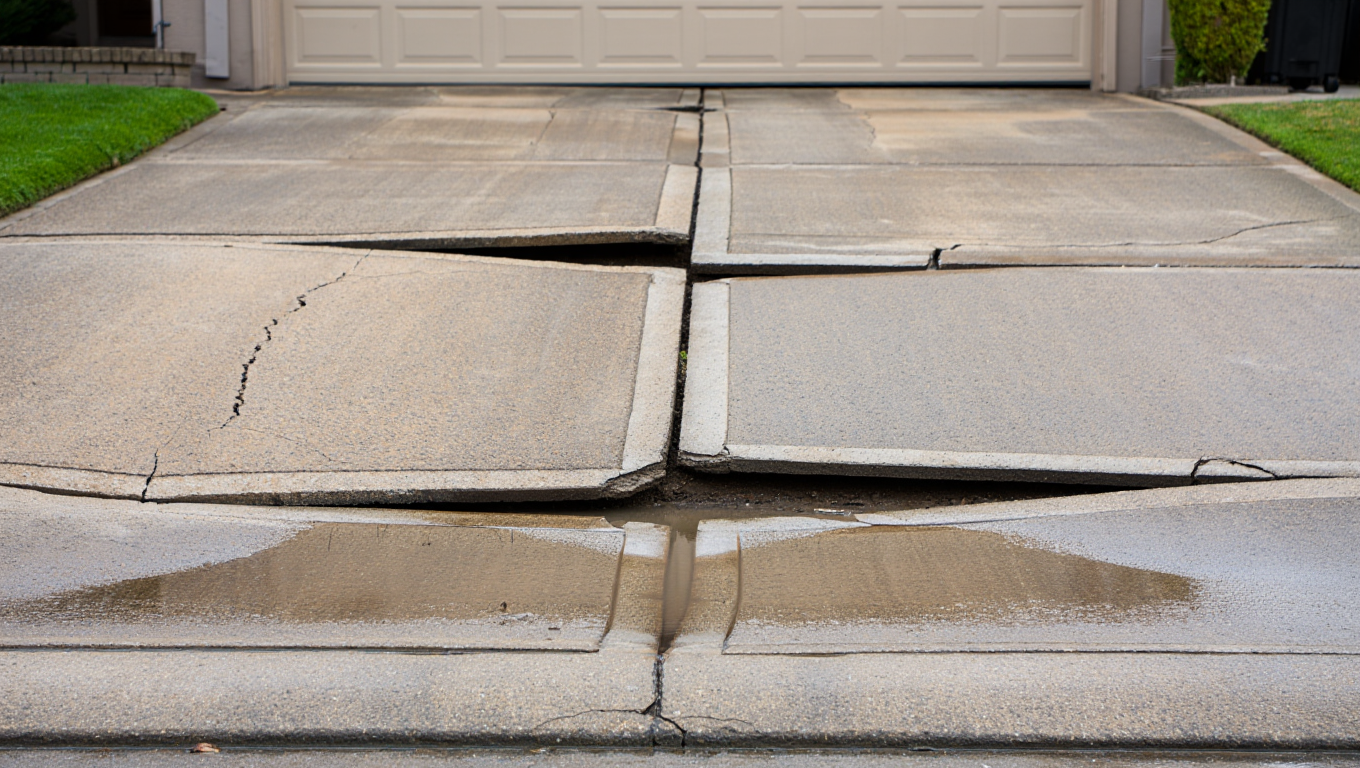 The Ideal Temperature Range for Mudjacking
Mudjacking companies and other professionals in the concrete repair industry prefer to work when temperatures are within a certain range. This generally accepted window for working with concrete is between 50°F (10°C) and 95°F (35°C).
Within this range, the pace of hydration is steady and predictable. Hydration is the process or chemical reaction that occurs between water and cement that turns the paste-like slurry into hard cement. This temperature range is the ideal setting for the material to become strong and not prone to shrinking or cracking prematurely.
Why 50°F (10°C)?
Mudjacking involves drilling holes and pouring a slurry underneath the concrete slab. This slurry is made up of a mixture of soil, sand, cement, and water. Once this mixture has been poured and stops moving, a chemical reaction begins, i.e., the slurry begins to cure.
According to experts, concrete will almost stop curing at around 40°F (4.4°C), but the curing process begins to slow down when temperatures hit below 50°F (10°C). That is why contractors would ideally want to work when the temperature has hit 50°F (10°C) or more.
Why 95°F (35°C)?
This is a limit set by the American Concrete Institute (ACI), a leading authority and resource worldwide that’s committed to improving concrete practices. According to the organization:
“ACI 301-20 ‘Specifications for Concrete Construction’ and ACI 305.1-14 ‘Specification for Hot Weather Concreting’ limit the maximum concrete temperature to 95°F (35°C) at the time of discharge. This limit is for general types of hot weather construction such as pavements, bridges, and buildings, not mass concrete.”
Mass concrete refers to projects that require large volumes of concrete, such as dams, bridge piers, and thick foundations.
Mudjacking & Cold Weather
“Cold weather” is defined by the American Concrete Institute (ACI) as “a period when the average daily ambient temperature is below 40°F (5°C) for more than 3 successive days.” This is important for contractors to consider, especially during the protection period, or the time required to prevent concrete from being affected by exposure to cold weather, in order to prevent damage.
So, while concrete can still be poured and cured in low temperatures, contractors will need to have an understanding of how cold weather impacts concrete. Many may prefer to postpone their work when the temperature starts falling or if there is a forecast freeze. The reason is simple: The mudjacking slurry has a significant amount of water in it, and when it begins to get chilly, this water can freeze and result in unwanted consequences.
What Happens to Concrete When Water Freezes?
There is a general consensus among mudjacking professionals that the absolute maximum in terms of coldness for any work to proceed is an air temperature of above 32°F (0°C), which is the temperature when water freezes.
If contractors work during freezing temperatures, they will face several problems:
Freeze-Thaw Cycle
In many climates, water in the slurry freezes at night (expanding) and thaws during the day (contracting). This cycle of expansion and contraction can cause progressive damage to the concrete slab.
Water Expansion
When temperature reaches 32°F (0°C) and below, it starts to expand. Unlike most materials whose solid form is denser than their liquid form, room temperature water will increase in volume by around 9% after freezing.
Remember that water in the slurry mixture is pumped under concrete slabs, so it’s not free to expand. Because of this confinement, its expansion is restricted and it puts massive pressure on the surrounding materials. In other words, when water freezes and expands, it forces the slab upwards and cause it to shift, buckle, or crack.
Disruption of the Curing Process
Concrete takes longer to cure the colder the temperature gets.
Decrease in Cement Strength
If the cement in the slurry mixture freezes soon after it is injected, it loses its potential strength if it had cured properly. Expert estimates state that the ultimate strength of concrete is reduced by up to 50% if it freezes soon after it is pumped.
Furthermore, the more water the slurry mixture has, they higher the likelihood of this water freezing and the cement to lose strength. Experts say that for each gallon of water, at least 200 psi of strength is lost.
Therefore, ensuring the slurry does not freeze during the curing process is critical to the success of mudjacking.
How Frozen Ground Affects Mudjacking
Aside from the air temperature, the temperature of the ground under the concrete is also critical. Frozen ground presents major issues.
False Height
Because water in the soil expands, it heaves the ground upward. If contractors pump mudjacking slurry when the ground is frozen, when the soil thaws, it will shrink back down. So, the final result will be concrete that has sunken again.
Pumping Problems
Another problem with mudjacking when the soil is frozen is this: Water in the ground that has become ice not only lifts it up but also fills any voids or small cracks. So, injecting mudjacking slurry will only result in uneven repair.
Thermal Lag
There’s also the issue of thermal lag, which is the time delay for heat to be conducted through a material. In the case of the concrete slab and the ground, both take longer to freeze but they also take longer to thaw out. So, even if the air is warmer, the soil and concrete might still be frozen cold. Contractors need to verify that the ground is warm enough to support a good repair job.
Mudjacking & Hot Weather
On the opposite end of the spectrum, mudjacking is also not ideal when the weather is hot. By this, we mean that the temperature is above 90-95°F (32-35°C). Similar to cold weather, mudjacking during hot weather conditions will also result in a bad repair.
Rapid Drying and Shrinkage
When temperatures are high, water begins to evaporate more quickly. As a result, the mudjacking slurry dries out and shrinks, which leads to the concrete slab dropping an inch or two.
Flash Setting
If cold temperature delays the curing process, hot weather speeds it up. Extreme heat can cause the slurry mixture to harden even while it is still inside the hose or pump, which clogs the equipment and prevents contractors from doing a good repair.
No Comments